
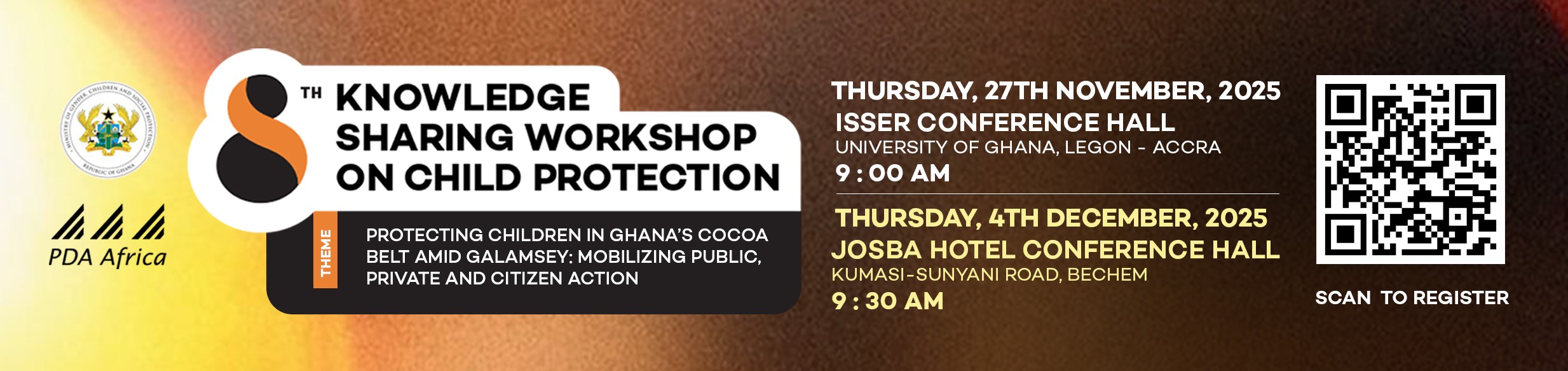
Participatory Development Associates (PDA), in partnership with the Department of Children under the Ministry of Gender, Children and Social Protection, convened the 8th Knowledge Sharing Workshop on Child Protection (KSWoCP) with two multi-level events in Accra and Bechem. The 2025 edition of the workshop brought together national and community stakeholders to address the growing threat of illegal mining galamsey to children in Ghana’s cocoa-growing regions.
Galamsey: A Child Protection Crisis
Speakers at both events stressed that galamsey is no longer just an environmental concern but a severe child protection crisis. Over 21% of children aged 5–17 in mining zones are engaged in hazardous labour, while contaminated water bodies, degraded farmlands, and weakened community structures continue to heighten their vulnerability.
The Accra session, held on 27th November at the ISSER Conference Hall, brought together policymakers, cocoa companies, researchers, development partners, and national media. Mrs. Annabelle Yeboah-Osei, Director of Operations at PDA, opened the session with remarks highlighting the urgent need to safeguard children, noting that national discourse has often overlooked the realities children face in mining-affected communities. Wendy Anane-Badohu of A Rocha Ghana described the scale of destruction as “heartbreaking,” explaining that galamsey has become so widespread and sophisticated that it is undermining education, food security, social cohesion, and the well-being of entire communities.
Abena Aprekua Badu-Aboagye of the Department of Children subsequently emphasized the need for stronger enforcement of Ghana’s child protection laws, especially at the district level, and the importance of community awareness to reduce the normalization of children’s involvement in mining. Dr. Joselyne Fulera Awari of the Pediatric Society of Ghana contributed the public health perspective, stressing that children in mining areas are increasingly suffering long-term harm from toxic exposure, violence, and exploitation. She warned that “the health impacts of galamsey on children will outlive the crisis itself if coordinated interventions are not urgently prioritized.”
The Accra session also featured a panel discussion on the theme “Protecting Children in Ghana’s Cocoa Belt amid Galamsey: Mobilizing Public, Private and Citizen Action.” Panelists included Abena Dufie Akonu-Atta from the Department of Social Welfare, Innocents Yeboah-Num of ETG | Beyond Beans, Kwadwo Kyei Yamoah, Executive Director of HELP Foundation Africa and a leading member of the Ghana Coalition Against Galamsey, and Priscilla Selinam Opoku, an independent development strategist. They discussed the drivers of children’s involvement in galamsey, gaps in community protection systems, and how public and private actors can work together to safeguard children while supporting sustainable livelihoods for families. A recording of the Accra session is available here.
The Bechem session, held on 4th December at the JOSBA Hotel Conference Room, engaged district assemblies, school authorities, social welfare officers, community leaders, and local child protection actors. Speaking from the frontline of education impacts, Mr. Hamid Kramo, Director of the Ghana Education Service for Ahafo Ano South East, described galamsey as a national crisis, stating: “The Hiroshima bomb in Japan is a less evil than the galamsey that is happening in Ghana now. It has already impacted education and children in my district, and the effects over the next five to ten years will be devastating.”
Plenary discussions in Bechem examined why children join galamsey activities, the barriers to preventing their involvement, and the protection gaps facing girls and other vulnerable groups. Participants mapped ongoing initiatives, highlighted resource and enforcement limitations, and developed short-term district-level interventions to strengthen child protection over the next three to six months.
Documentary Premiere
Both events featured the premiere of a PDA-produced mini-documentary capturing the experiences of families and children living in galamsey-affected cocoa-growing communities. The documentary, which can be viewed here, sparked emotional responses in both Accra and Bechem and reinforced the urgent need for stronger collaboration across government, cocoa companies, civil society organizations, and communities to minimize the adverse effects of illegal mining on children.
Moving Forward
Participants underscored that addressing the child protection crisis linked to galamsey requires coordinated action across government, the private sector, civil society, cocoa companies, and local communities. Young Joo Lee, a Child Protection Specialist at UNICEF Ghana, reinforced these recommendations by urging stakeholders to integrate national child protection tools in their interventions, strengthen district coordination, and co-invest in preventive and responsive services. She also emphasized the importance of evidence generation and responsible business practices to safeguard children and reduce risks across cocoa and mining supply chains.
PDA will continue collaborating with its partners to advance evidence-based solutions, strengthen district-level child protection systems, and promote responsible, child-centered practices across Ghana’s cocoa value chain. As a social development organization committed to ethical and inclusive development, PDA together with its not-for-profit arm, PDA Africa, remains guided by the principle that Everyone Matters—especially the children whose futures we strive to protect.